NDIS Employment Support Tasmania: What It Is and How to Access It
Work means different things to different people. For some, it is financial independence. For others, it is routine, connection, and a reason to get up in the morning. For many Tasmanians living with disability, meaningful employment is something they want, and something the NDIS is specifically designed to help make possible.Yet for all the talk of employment inclusion, many NDIS participants and their families are still unsure what employment support actually looks like on the ground. What does it cover? Who can access it? And how do you actually get it included in your plan?This guide answers all of that. If you or someone you support is based in Tasmania (whether in Hobart, Launceston, or a regional community), read on to understand exactly how NDIS employment support works and what Goodwill Support can do to help.
What Is NDIS Employment Support?
NDIS employment support refers to a category of funded services designed to help participants with disability find, prepare for, and maintain work. It is not a single service but a suite of supports that can be tailored to your individual goals, capacity, and circumstances.Employment support is primarily funded through the Capacity Building: Employment budget in your NDIS plan. This is separate from your Core Support budget and is specifically ring-fenced for employment-related goals.Employment support can include things like: career counselling and vocational assessment, help with job applications and interview preparation, on-the-job support and workplace modifications, transitioning from school into the workforce, and longer-term
supported employment in a structured environment.
Good to know: You do not need to be job-ready to access
employment support. Many supports are specifically designed for people who are still building the skills, confidence, and independence needed for work.
Types of NDIS Employment Support Available in Tasmania
Tasmania has a growing range of NDIS-registered providers offering employment support services. The main categories funded by the NDIS are:
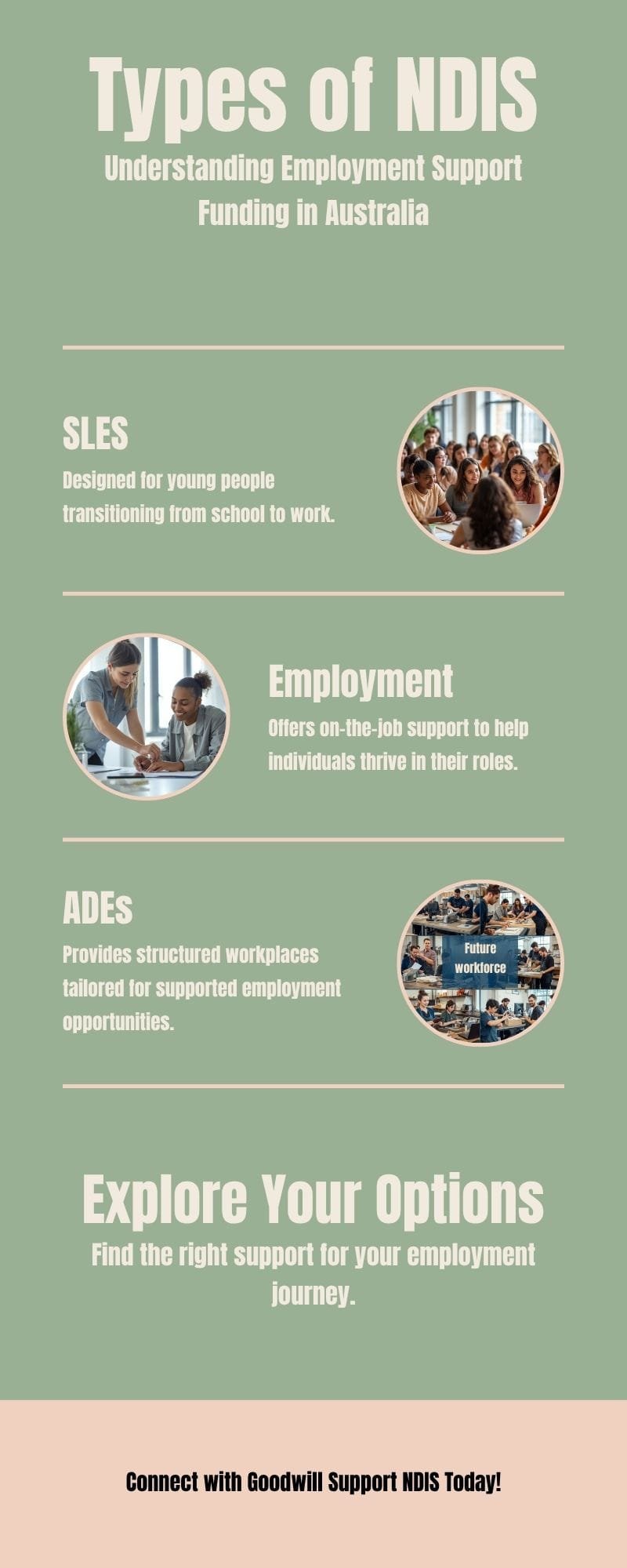
1. School Leaver Employment Supports (SLES)
SLES is designed for young people who are leaving school and starting to think about their future in work and community life. It is available for up to two years after a participant leaves school, and focuses on building work-readiness skills rather than placing someone in a job immediately.This might include volunteer or trial work experiences, learning workplace communication and behaviour, building travel training skills to get to and from work independently, and exploring different career interests and pathways.For families in Hobart and Launceston, SLES can be one of the most impactful supports in a young person’s plan. Starting early and building gradually gives participants the best chance of long-term employment success.
2. Support in Employment (Individual Placement)
This is support provided to participants who are working or actively looking for work in the open employment market. A support worker or employment specialist assists you directly in the workplace, helping with tasks, communication, building relationships with colleagues, and managing the natural demands of a job.This type of support is flexible and individualised. It can be intensive at the start (for example, daily support in your first weeks on the job) and gradually reduce as you become more confident and settled.
3. Supported Employment (Australian Disability Enterprises)
For participants who need more ongoing and structured support, supported employment through Australian Disability Enterprises (ADEs) provides paid work in a specialised setting. These are NDIS-registered businesses that employ people with disability, offering a supported workplace environment with co-workers and supervisors who understand individual needs.There are several ADEs operating in Tasmania, including in the Hobart and Launceston regions, providing opportunities in areas such as manufacturing, packaging, hospitality, and garden maintenance.
4. Employment-Related Assessment and Counselling
Before entering the workforce, or when re-evaluating career direction, participants can access professional vocational assessment and counselling through their NDIS plan. This helps to clarify strengths, interests, and realistic pathways based on the participant’s disability and functional capacity.This support is particularly useful at plan reviews or when a participant’s goals around work are changing.
How Is Employment Support Funded in Your NDIS Plan?
Understanding how the NDIS funds employment support helps you have a more productive conversation at your planning meeting or plan review.Employment support sits under the Capacity Building budget, specifically in the Employment support cluster (CB-Employment). This budget is not interchangeable with your Core Support; it can only be used for the employment-related services listed in your plan.The amount of CB-Employment funding you receive depends on the goals in your plan. If your plan does not include employment as a goal, it is very unlikely you will receive this funding, even if you want to work.
At your planning meeting, be specific about your employment goals. Say something like: ‘I want to find part-time work within the next 12 months’ or ‘I want to build the skills to be job-ready by the time I leave school.’ Vague statements like ‘I might want to work someday’ are less likely to generate funded employment supports.If you already have NDIS funding but employment is not currently in your plan, you can request an unscheduled plan review to add it. Your support coordinator (if you have one) can help you navigate this process.
Plan tip: The NDIS separates finding a job from keeping a job. Make sure your goals and your plan reflect both: job-seeking supports and on-the-job supports are funded differently and should both be requested where relevant.
NDIS Employment Support in Hobart
As the state capital, Hobart offers the broadest range of employment opportunities for NDIS participants in Tasmania. The city has a growing economy across government, health, hospitality, tourism, and the arts, sectors that often have roles well-suited to people with diverse abilities and flexible work arrangements.Goodwill Support works with participants across
greater Hobart, from Kingston and Glenorchy to Clarence and the Eastern Shore, to connect them with employment goals that are realistic, sustainable, and genuinely meaningful to them.Our employment support team in Hobart focuses on relationships as much as résumés. We get to know what motivates each participant, what kind of environment they thrive in, and what ‘work’ looks like on their terms. For some that is full-time open employment. For others it is a few hours of supported work per week alongside community activities.We also work closely with local Hobart employers who are open to inclusive hiring and are willing to make reasonable adjustments. Building these employer relationships means our participants have real pathways into real workplaces, not just theoretical options.
NDIS Employment Support in Launceston and Regional Tasmania
Employment support outside of Hobart is an area where many Tasmanian NDIS participants feel underserved, and for good reason. The tyranny of distance, smaller labour markets, and fewer registered providers have historically made it harder to access quality supports in regional areas.Goodwill Support is committed to changing that. We provide employment support services in
Launceston and across northern and north-west Tasmania, including in-person support where geography allows and flexible arrangements where it does not.In Launceston, the economy is anchored in retail, logistics, agriculture, and food manufacturing, industries with genuine entry-level and supported employment opportunities. Our Launceston employment team understands the local job market and works with participants to identify the openings and the employers that fit.For participants in more remote parts of Tasmania, we can also deliver elements of employment support via telehealth-compatible approaches, ensuring that geography does not determine access to quality services.
Who Is Eligible for NDIS Employment Support?
To access NDIS employment support, you first need to be an NDIS participant, meaning you have an approved NDIS plan. Beyond that, the key eligibility requirement is that employment is a goal in your current plan.There is no specific age requirement for employment support other than the general NDIS age eligibility (under 65 at the time of entry to the scheme), but in practice, employment support is most commonly accessed by participants aged 15 to 55.School Leaver Employment Supports (SLES) specifically apply to participants who have recently left school or are in their final year of schooling. The NDIS recognises this as a critical transition period and funds it accordingly.You are likely eligible for employment support in your plan if you: have a permanent disability that affects your ability to find or maintain work; have a goal around employment, volunteering, or work readiness in your current plan; are under 65 years of age; and are not receiving the same supports through
Disability Employment Services (DES), which is a separate, complementary government program.
Important: NDIS employment support and Disability Employment Services (DES) are different programs. You can access both simultaneously, but they serve different functions. DES focuses on job placement in the open market. NDIS employment support covers on-the-job assistance, skill-building, and supports that DES cannot fund.
How to Access NDIS Employment Support with Goodwill Support
Getting started is simpler than it sounds. Here is how participants in Tasmania typically access employment support through Goodwill Support:
- Check your current NDIS plan for CB-Employment funding. If it is there, you can start using it right away.
- If your plan does not include CB-Employment funding, speak with your LAC (Local Area Coordinator) or support coordinator about adding employment goals at your next review or in an unscheduled review.
- Contact Goodwill Support to discuss your employment goals and which services would best match your needs and plan.
- We will complete an onboarding process, agree on a service agreement, and develop an individualised employment support plan with you.
- You begin receiving services at a pace and intensity that works for you.
What makes Goodwill Support different is our commitment to the whole person, not just the job outcome. Employment is deeply tied to self-esteem, identity, and wellbeing. We believe that getting to work is important, but so is making sure the work is the right fit, at the right time, in the right environment.Our employment support coordinators are experienced in navigating the NDIS, working with participants across a wide range of disabilities and backgrounds, and building genuine relationships with local Tasmanian employers. You can learn more about our employment support services at
goodwillsupport.com.au/our-services/employment-support/ or contact our team directly.
Frequently Asked Questions: NDIS Employment Support in Tasmania
Q: Can I access NDIS employment support if I am already working part-time?Yes. NDIS employment support is not limited to people who are currently unemployed. If you are working part-time and need support to increase your hours, improve your performance, or manage workplace challenges, you may be eligible for on-the-job support through your NDIS plan. Speak with your LAC or support coordinator about updating your plan goals to reflect this.
Q: What is the difference between NDIS employment support and Disability Employment Services (DES)?DES is a federally funded job placement program that helps people with disability find work in the open employment market. It is free to access and does not require NDIS funding. NDIS employment support, on the other hand, is individualised and funded through your NDIS plan; it covers things DES cannot, such as on-the-job support workers, school leaver transition supports, and employment-related skill development. Many participants use both programs at the same time.
Q: How much NDIS funding do I need for employment support in Tasmania?There is no fixed minimum amount. The funding in your CB-Employment budget depends on your goals and the supports your planner agrees are reasonable and necessary. Some participants receive a few thousand dollars for career counselling and assessments, while others receive significantly more for ongoing on-the-job support. The key is to clearly articulate your employment goals at your planning meeting with specific, measurable outcomes.
Q: My child is finishing school next year. How do I get School Leaver Employment Supports included in their plan?SLES needs to be requested and approved as part of your young person’s NDIS plan. Ideally, you should raise this at the year before their final year of school. Contact your LAC or support coordinator and specifically request that SLES be included as a Capacity Building Employment goal. The NDIS recognises the school-to-work transition as a priority, so plans developed during this period are generally well-funded for SLES when requested properly.
Q: Does Goodwill Support offer employment support in regional Tasmania, not just Hobart?Yes. Goodwill Support provides employment support services across Tasmania, including Launceston, Devonport, Burnie, and other regional areas. We understand that access to services outside the capital has historically been a challenge for many participants, and we have structured our team to be able to deliver quality support state-wide. Contact us to discuss what is available in your specific area.
Q: What happens if I start a job but it does not work out? Will I lose my NDIS employment funding?No. If a job does not work out, your NDIS plan and funding do not automatically change. You can continue accessing employment support to explore other options, learn from the experience, and try again. The NDIS understands that the path to sustainable employment is rarely a straight line, and your plan can be reviewed and adjusted as your circumstances and goals evolve.
Ready to Take the Next Step?
Whether you are a parent planning ahead for your child’s transition out of school, an NDIS participant ready to re-enter the workforce, or someone who has never worked before and is wondering if it is even possible: we would love to talk.Goodwill Support is a
registered NDIS provider based in Tasmania, with a team of dedicated employment support specialists who understand the local job market and are genuinely invested in helping each participant find their place in it.You can reach us through our website at
goodwillsupport.com.au, or explore our full range of NDIS supports at
goodwillsupport.com.au/our-services/. If you are new to the NDIS, our introductory guide,
The Complete Guide to NDIS Support in Tasmania, is also a great place to start.
Employment is not a privilege. It is a right. And with the right support in place, it is within reach for more Tasmanians with disability than most people realise. Let’s find out what is possible for you.