
What Is Respite Care Under the NDIS? A Guide for Tasmanian Families

Caring for someone you love is one of the most meaningful things you can do. It can also be exhausting, relentless, and isolating in ways that are hard to put into words.
Respite care gives carers a break. It gives the person with disability a chance to spend time in a different environment, try new activities, and build their independence. Done well, it benefits everyone.
If you’re a Tasmanian family navigating the NDIS and wondering whether respite care is something you can access, this guide is for you. We’ll explain what it covers, how to get it funded, and what to look for in a good provider.
What Is Respite Care?
Respite care refers to temporary support provided to a person with disability, which gives their usual carer time to rest, recover, or attend to other responsibilities. The word ‘respite’ literally means a short period of relief from something difficult or unpleasant.
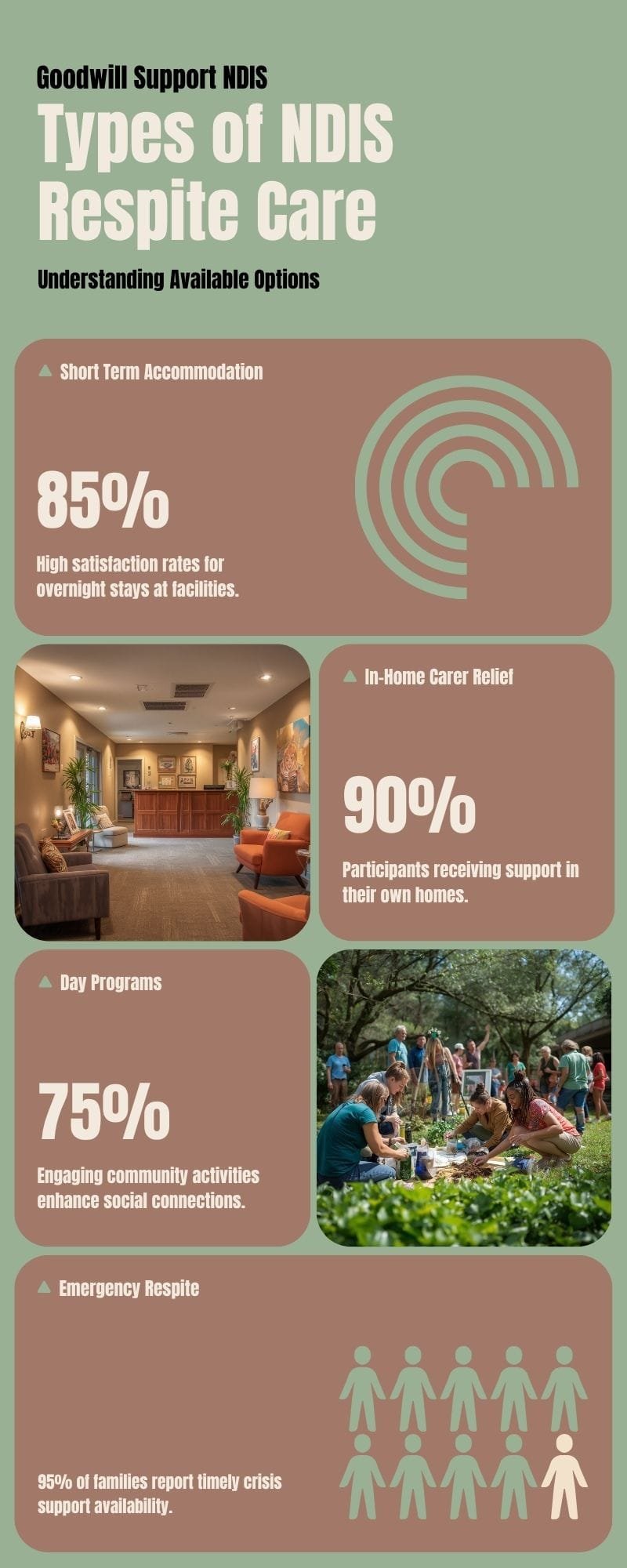
In the NDIS context, respite care takes several forms. It can be a few hours of in-home support while a carer attends an appointment. It can be a day program where the participant engages in community activities. It can also be an overnight or multi-day stay at a supported accommodation facility.
The NDIS doesn’t use the term ‘respite’ in its official language. Instead, it refers to these supports as Short Term Accommodation (STA) and Medium Term Accommodation (MTA), as well as in-home carer relief supports funded through Core Supports.
Why Respite Matters
Carer burnout is real. Research consistently shows that informal carers in Australia face higher rates of depression, anxiety, and physical health problems than the general population. Tasmanian carers are no exception.
Regular breaks help carers sustain their caring role over the long term. They also give participants the opportunity to experience new environments, socialise with peers, and practise the independence skills they’ve been building.
Many families tell us they feel guilty asking for respite. Please don’t. Accessing respite care isn’t a sign of failure. It’s a sign that you’re taking care of yourself so you can keep taking care of the person you love.
How the NDIS Funds Respite Care
Respite supports sit within the Core Supports budget in your NDIS plan, under the Assistance with Daily Life category. This means they share a pool of funding with other daily support services.
Short Term Accommodation (STA) is the most common form of respite funded by the NDIS. It covers accommodation and support for a participant away from their home, typically for between one and 14 days.
What Short Term Accommodation Covers
STA funding covers the cost of the accommodation itself, as well as the support the participant needs while they’re there. The NDIS sets a daily price limit for STA, which varies depending on the level of support required.
STA can be used in a range of settings. Registered respite houses, group homes, and dedicated disability accommodation facilities all qualify. Some providers also offer STA in shared arrangements, where a participant stays with others in a supported setting.
The NDIS does not fund STA in hotels or standard holiday accommodation, even if a support worker is present. The accommodation itself must be provided by a registered NDIS provider.
In-Home Carer Relief
Not all respite involves the participant leaving home. In-home carer relief brings a support worker to the family’s home, so the carer can step away for a few hours. This works well for participants who are distressed by changes in environment, or for families who simply need a short-term break without the logistics of an overnight stay.
This type of support uses the Assistance with Daily Life budget rather than STA. Your LAC or support coordinator can help you determine which type of funding applies to your situation.
Tip: If respite isn’t in your current plan, don’t wait for your next scheduled review. You can request an unscheduled plan review if your caring situation has changed significantly. Speak with your LAC or contact the NDIS on 1800 800 110.
Types of Respite Available in Tasmania
Tasmania has a range of respite options available across the state, though availability outside Hobart and Launceston can be more limited. Here’s a breakdown of what you’ll find.
Short Term Accommodation (STA)
STA is the most structured form of NDIS respite. Participants stay at a registered facility for a set number of days, with all support provided by the facility’s team. STA works well for participants who enjoy the social aspect of staying with others, or for families who need a longer break.
In Hobart, several registered providers offer STA services with different levels of support, from low-intensity options for participants with mild needs, to high-intensity support for people who require complex care around the clock.
Day Programs and Community Access
Day programs give participants a structured day of activities outside the home, without an overnight component. These programs run through NDIS-registered providers and often include social activities, life skills training, and community outings.
For carers, a full day program provides several hours of relief. For participants, it’s an opportunity to connect with peers, try new experiences, and build independence in a supported environment.
Goodwill Support offers community access supports across Tasmania, including in Hobart and Launceston. Our team works with each participant to find activities that match their interests and goals.
In-Home Respite
A support worker comes to your home and takes over the caring responsibilities for a set period. The carer can use this time however they need: rest, medical appointments, work, or simply time for themselves.
In-home respite can be booked as a one-off or set up as a regular arrangement. Many families find a weekly or fortnightly in-home session makes a significant difference to their sustainability as carers.
Emergency and Planned Respite
Sometimes families need respite in a hurry. If a carer falls ill, is hospitalised, or faces an unexpected crisis, emergency respite can be arranged at short notice. This is funded differently from planned STA and may involve contact with both the NDIS and state-based carer support services.
Planned respite, on the other hand, is booked in advance and forms part of your regular plan usage. It’s worth planning your respite early in the plan year to ensure funding is available and you can secure your preferred provider and dates.
Who Can Access NDIS Respite Care in Tasmania?
To access NDIS-funded respite care, the participant must be an active NDIS participant with relevant supports included in their plan. Respite doesn’t always appear explicitly in a plan; it can be accessed through Core Supports funding when a participant has daily living assistance included.
Eligibility Considerations
There is no specific diagnosis or disability type required for respite. What matters is that the participant has an NDIS plan and the funding covers the relevant support category.
The carer’s situation also plays a role. NDIS planners consider the informal support network around a participant when determining the level of funded support needed. If a carer is struggling or unavailable, this strengthens the case for more respite funding.
Families who are not yet on the NDIS may be able to access some respite through the Carer Gateway, a federal government program that provides carer support services including emergency and planned respite. Contact the Carer Gateway on 1800 422 737 for more information.
What to Say at Your Planning Meeting
Be honest and specific about your caring situation. Planners respond to concrete information: how many hours a day does the carer provide support? Does the carer have health issues of their own? Is there anyone else who shares the caring role?
Say clearly: ‘We need respite to sustain the caring arrangement.’ If you have a specific number of days of STA in mind, ask for it. Vague requests produce vague funding.
Note: Carers are not NDIS participants themselves. The NDIS funds supports for the person with disability. However, by funding respite and in-home support for the participant, the scheme indirectly provides relief for the carer.
Respite Care in Hobart
Hobart has the highest concentration of NDIS respite providers in Tasmania. Families based in the greater Hobart area, including Kingston, Glenorchy, Clarence, and Huon Valley, have access to a range of STA options, day programs, and in-home respite services.
Goodwill Support provides in-home respite and community access supports across the Hobart region. We match participants with support workers who understand their needs and build genuine relationships over time.
Consistency matters in respite. A familiar face makes a real difference, especially for participants who find change difficult. We prioritise matching participants with the same support workers so each respite experience feels safe and positive.
Finding the Right Provider in Hobart
When choosing a respite provider in Hobart, ask about their experience with your family member’s specific disability. Ask about staff ratios during STA stays. Find out how they handle medical needs or behavioural support requirements during overnight stays.
You’re not just booking a service. You’re trusting someone with a person you love. Take the time to visit a facility or meet a team before committing.
Respite Care in Launceston and Regional Tasmania
Respite options in Launceston and regional Tasmania are growing, but availability can be more limited than in Hobart. Families in northern and north-western Tasmania may find fewer STA facilities and longer wait times for certain services.
Goodwill Support provides in-home respite and community access services in Launceston and surrounding areas. We understand the additional challenges that come with accessing disability supports in regional Tasmania and work to bridge the gaps where we can.
Regional Planning Tips
If you’re in a regional area, book planned respite well in advance. Availability fills up quickly, particularly during school holidays when demand peaks. Ask your support coordinator to help you lock in dates early in your plan year.
Also consider whether telehealth-supported planning conversations are available to you. Some of the preparation and coordination work around respite can happen remotely, reducing the need to travel.